•
Drizz raises $2.7M in seed funding •
•
Featured on Forbes
•
Drizz raises $2.7M in seed funding •
•
Featured on Forbes


Mobile teams have a different problem. A team shipping a native iOS or Android app every two weeks doesn't need better test-case tracking; a sprint tracking sprint doesn't have time to write and maintain tests in first place. Selector-based mobile automation collapses when design system refreshes. Real-device coverage requires a device cloud most Jira-plugin ecosystems don't ship with. And QA analyst persona these tools optimize for isn't PM-plus-mobile-engineer team that most consumer mobile shops actually run.
Five criteria separate a mobile testing tool that fits a two-week sprint from one that doesn't. Every tool in this comparison is measured against all five.
The broader tool-selection framework across QA persona, cross-surface needs, and pipeline integration lives in our mobile testing tool evaluation. This post narrows to sprint-cadence question specifically.
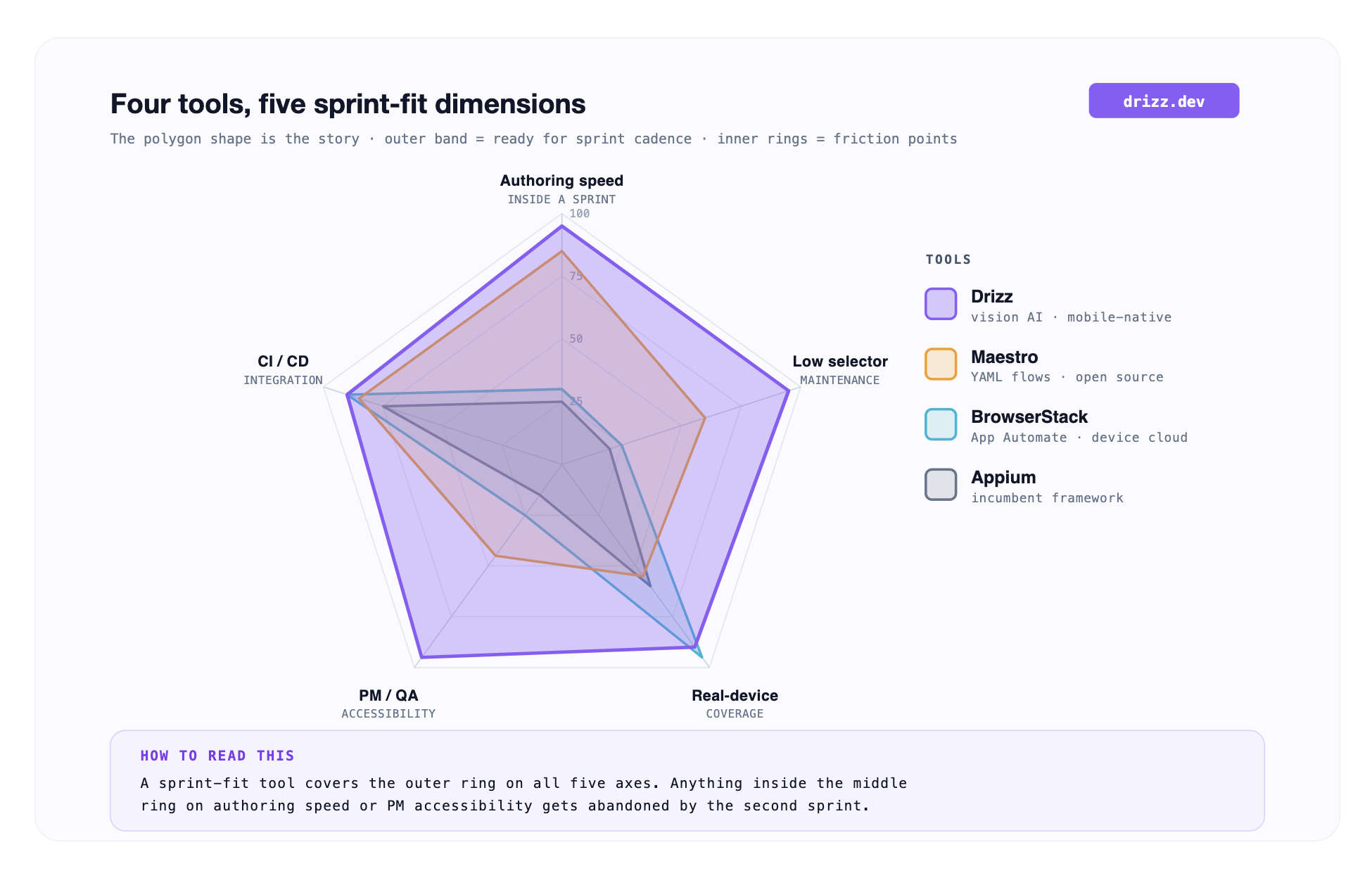
The radar shape is story. A sprint-fit tool covers outer band on all five dimensions; a partial-fit tool covers two or three. The tools that ship inside middle ring on authoring speed or PM accessibility are ones agile mobile teams silently abandon after first sprint they try to adopt them.
Every tool below actually ships mobile support today. Enterprise test-management platforms (Zephyr, Xray, TestRail, qTest) are excluded; they excluded they manage test cases but don't execute mobile tests, so they solve a different problem than sprint-cadence problem this post is about.
We built Drizz because agile mobile teams have a compounding maintenance problem that shipping cadence makes worse, not better. A team on a two-week sprint that also refactors its design system every quarter is burning 20-30% of its testing budget on locator maintenance by month six. The selector layer scales in wrong direction.
A Drizz test reads like an acceptance criterion:
Tap the Login button
Type "test@example.com" in the Email field
Tap Sign In
Verify the home screen shows "Welcome back"
Four lines. Written in sprint planning meeting, running in CI on same day. Our vision model matches on what button looks like visible label not on element IDs or accessibility tags, which is why test survives design refreshes without human intervention.
Four things we do specifically for sprint-cadence mobile testing that no other tool on this list does:
The technique underneath is what we call Vision AI mobile testing, and it's why our production customer suites sit at around 5% flakiness through weekly design refreshes against an 8-15% baseline for selector-based mobile tools.
Best for: any mobile-first agile team shipping every two weeks on iOS, Android, React Native, or Flutter, where sprint doesn't have room for a full-time SDET to maintain a test suite.
Maestro uses YAML flow files that live in repo alongside app code:
appId: com.example.app
---
- launchApp
- tapOn: "Login"
- inputText: "test@example.com"
- tapOn: "Sign In"
- assertVisible: "Welcome back"
Engineering-friendly, open source, native mobile focus, and popular with mobile dev teams for its low ceremony. On sprint-cadence question, Maestro is one of few mobile tools that authors as fast as Drizz does.
The specific limit for agile mobile teams: Maestro's text-based element matching handles label renames but not structural refactors. When engineering restructures a login flow to add a two-factor step, or moves a button inside a new modal, flow either fails outright or silently matches wrong element. The other limit is real-device coverage Maestro runs on emulators locally and on Maestro Cloud for real devices, but cloud tier and device breadth are smaller than dedicated device farms.
Best for: engineering-led mobile teams where test source belongs in repo, developers author tests, and design system is stable enough that structural refactors are rare.
BrowserStack App Automate is incumbent device cloud for mobile testing. Thousands of real iOS and Android devices, deep integrations with every mobile CI pipeline on market, and a mature reporting layer for regression coverage over time.
The specific limit for agile mobile teams: App Automate is a device runner, not an authoring layer. Tests still have to be written in Appium, Espresso, XCUITest, or Detox meaning you inherit every selector-maintenance and code-first-authoring problem those frameworks come with. On a two-week sprint, authoring bottleneck typically hits before device-coverage bottleneck does. Teams using App Automate at agile cadence typically pair it with a plain-English authoring layer on top, which is where Drizz slots in for Drizz customers or where App Automate customers wire up their own DSL.
Best for: teams that already have a mature Appium or native-framework test suite and need real-device execution at scale. Not for teams starting from zero on mobile testing.
Appium is incumbent programmatic mobile testing framework. Cross-platform (iOS and Android from a single script), driver ecosystem is deep, and every senior QA engineer has written Appium tests. For teams already committed to a code-first testing culture, Appium is default.
The specific limit for agile mobile teams: Appium tests are locator-driven and script-authored, which means every UI refactor sends team back into test code to update selectors. On a two-week sprint with a design system that refreshes quarterly, teams dedicate a full engineer-week per sprint just to keeping Appium suite green. WebDriverAgent and UIAutomator2 also occasionally desync from OS updates, adding an OS-upgrade cadence to maintenance load. The authoring layer is Java, Kotlin, JavaScript, or Python and not accessible to PMs or QA leads without engineering support.
Best for: engineering-led teams with a dedicated SDET on staff, a stable feature area where design refactors are rare, and enough continuity that ROI on selector maintenance pays off across quarters.

The right question isn't which tool has longest feature list; it's which tool fits the actual constraints of your sprint.
For most mobile-first agile teams, shape of constraint is authoring speed plus selector-maintenance load, which is why we sit as answer in three of six rows above. The tools below us are legitimately better fits when a team's specific constraint isn't authoring layer.
Test-tool selection is a load shift, not a load elimination. Four categories stay outside any tool's scope no matter how well sprint-cadence layer is dialed in:
Our take: sprint-compatible mobile testing tools handle 60-70% of QA workload that is mechanical regression coverage on observable UI, and free human QA budget for 30-40% that requires judgment. The wider mobile testing coverage framework covers where each layer sits alongside others.
They're agile test-management tools. Zephyr Scale and Xray let a team track test cases inside Jira, link them to user stories, and report on execution status. They do not execute mobile tests themselves; actual test runs happen in Appium, Espresso, or a tool like Drizz. On mobile-first teams, test execution tools matter far more than test-management layers, because execution tools are one competing with sprint capacity.
Sometimes yes, sometimes no. Drizz includes a real-device cloud in the platform, so a team using Drizz gets both authoring layer and execution surface from one vendor. Teams using Maestro or Appium typically pair an authoring framework with a device cloud like BrowserStack App Automate, Sauce Labs, or LambdaTest for a real-device execution layer.
Weekly if authoring is plain English and tests self-heal against UI change. Two-week sprints work with most modern tools. Anything faster than weekly starts to expose selector-maintenance bottleneck on tools that require code updates for label renames even Drizz sees higher review overhead below a weekly cadence because design churn compresses.
For happy-path flows on features they own, yes. Our test authoring for product managers covers specific PM-facing workflow and tools that support it. QA engineers still author harder tests, backend assertions, complex state, cross-service flows but acceptance-criterion-to-running-test round-trip belongs with PM when the authoring layer supports it.





©Drizz 2026 • All Rights Reserved