•
Drizz raises $2.7M in seed funding •
•
Featured on Forbes
•
Drizz raises $2.7M in seed funding •
•
Featured on Forbes


Data testing tools validate that data flowing through your pipelines is complete, schema-compliant, and accurate before broken data reaches a dashboard, a payout system, or an ML model. The category has grown fast since 2020 because cost of shipping bad data has grown faster. A single wrong row in a Snowflake table can misfire ten downstream reports; a schema drift in a Kafka topic can silently break every consumer for a week. Data engineers now treat testing as a first-class engineering practice, not a data-analyst afterthought.
The tools split into four categories. Code-first quality frameworks let engineers write assertions in Python, SQL, or Scala. Enterprise ETL validation platforms automate source-to-target reconciliation at scale. Data diffing and reconciliation tools show exactly which rows changed between two states of a dataset. Data observability platforms monitor freshness, volume, distribution, and lineage in production.
A data testing tool runs programmatic checks against a dataset, a table, a stream, a file, or a query result and fails or alerts when data violates a rule you've written. The rule can be structural (this column must be a non-null integer), statistical (this daily row count must be within 15% of yesterday's), or business-logical (every order row must reference a valid customer). Most tools ship with a library of common rules and let engineers add custom SQL or Python.
The core value is catching data problems before they surface downstream. A test that fails at 3:04 am on ingestion pipeline is a Slack alert to an on-call engineer. That same problem discovered at 9:00 am by a business user reading a dashboard is an outage. Data testing tools move discovery point from "when report broke" to "when pipeline ran."
Every leading data testing tool in 2026 sits inside one of these four boxes.
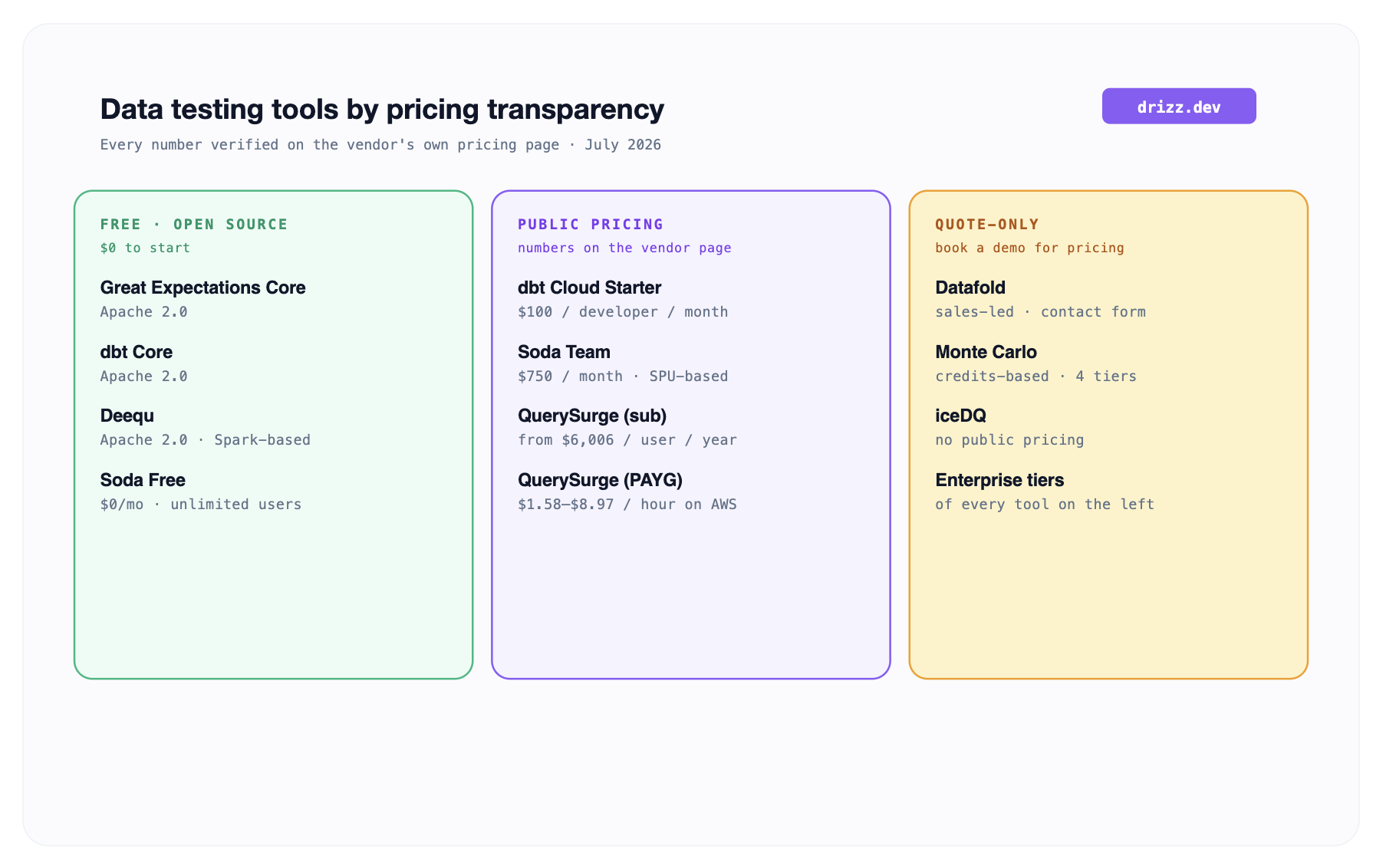
Three of eight publish real dollar figures on their own pricing page. Four are quote-only. The rest are free and open-source. That distribution matters when you're building a shortlist; quote-only vendors will spend two to three weeks in a sales cycle before you see a number, and free/OSS tools can be running in a proof-of-concept before end of sprint.
Code-first frameworks let engineers write assertions in their pipeline language. Each one of three below is open-source at its core.
Great Expectations (GX) is an open-source Python framework that popularized "data testing as software engineering." Engineers write assertions called expectations that check schema, distribution, referential integrity, and custom logic against pandas dataframes, Spark dataframes, or SQL query results. The framework generates automatically updated documentation that describes what a dataset should look like.
Pricing: GX Core is free under Apache 2.0. GX Cloud offers commercial tiers (Developer / Team / Enterprise) with a free Developer tier; pricing page names tiers but does not publish dollar amounts for Team or Enterprise.
Best for: Python-first data teams that want programmatic control over assertion logic and auto-generated docs that non-engineers can read.
Where it comes up short: setup curve is real. Teams typically spend 2-3 weeks getting initial configuration, connectors, and Data Docs generation dialed in. Simpler tools (dbt tests and Soda) start delivering value faster if your assertions are straightforward.
dbt is an analytics engineering tool that turned SQL into an application development discipline. Its built-in tests unique, not_null, accepted_values, relationships, plus custom singular and generic tests run inside dbt build pipeline itself, so every transformation gets validated as part of pipeline.
Pricing: dbt Core is free under Apache 2.0. dbt Cloud has published pricingpricing for DeveloperDeveloper at $0 (1 seat, 3,000 models/month, 1 project), Starter at $100 per developer per month;, and Enterprise / Enterprise+ tiers with custom quotes. Enterprise pricing is not published on page.
Best for: SQL-based analytics teams already using dbt for transformations. If code and tests live in same repo, tests get run and maintained by default.
Where it comes up short: dbt tests are constrained to shape of dbt's model-based paradigm. Streaming pipelines, complex statistical tests, and non-SQL data (files, APIs, blobs) all sit outside dbt's native model. Teams often pair dbt tests with Great Expectations or a data observability platform for these cases.
Deequ is Amazon's open-source data quality library built on top of Apache Spark. It profiles massive datasets, generates constraint suggestions automatically, and validates unit-test-style rules across multi-terabyte data lakes. Deequ is a reference open-source tool for Spark-based data quality.
Pricing: Free and open-source, Apache 2.0 licensed on GitHub. No commercial tier exists; you self-host and self-support.
Best for: teams running Spark on EMR, Databricks, or a self-managed Hadoop cluster who need to validate huge datasets that would time out on non-distributed frameworks.
Where it comes up short: Deequ is Spark-only and Scala-first. If your stack is Python-first or your data is not on Spark, Deequ is wrong tool. The community activity is also less consistent than dbt or Great Expectations, so long-term maintenance planning matters.
Enterprise ETL validation platforms handle high-scale source-to-target reconciliation with a heavier feature set, visual workbenches, rule libraries, audit trails, and cloud-migration-specific workflows.
QuerySurge is a purpose-built ETL testing platform for continuous DevOps integration. It automates validation of massive data volumes migrating into cloud data warehouses (Snowflake, BigQuery, Redshift) and integrates with every major CI/CD system.
Pricing: QuerySurge is unusual for enterprise category in publishing detailed licensing and pricing. Real numbers listed:
Perpetual licenses add 18% annual maintenance.
Best for: enterprise data QA teams running large migrations who need a proper commercial tool with per-user licensing, on-premises deployment, and formal support.
Where it comes up short: price tag is real. Small and mid-market data teams almost always find that open-source frameworks (Great Expectations and dbt tests) plus a lighter observability layer deliver comparable value at a fraction of total cost.
iceDQ is an enterprise rule-based test automation engine optimized for cloud migrations and production data auditing. Common use cases: Netezza → Snowflake migrations, Salesforce → Snowflake reconciliation, ongoing production auditing for regulated industries.
Pricing: iceDQ does not publish pricing on their site. Prospects are directed to book a demo from iceDQ homepage for a quote.
Best for: enterprises running a specific cloud-migration project with a defined validation scope and budget for a commercial tool.
Where it comes up short: lack of public pricing is a friction point during evaluation. Teams comparing multiple vendors often struggle to get iceDQ into a proper apples-to-apples comparison against tools that publish figures.
Data diffing tools show value-by-value differences between two states of a dataset, typically triggered from pull requests. Only one player leads this category at meaningful scale in 2026.
Datafold is a CI-native data diffing platform that integrates with GitHub and GitLab to show exactly which table rows and columns will change before a pull request merges. This is especially valuable during dbt model refactors and data-migration projects where blind refactors can silently corrupt downstream tables.
Pricing: Datafold does not publish pricing. The /pricing page redirects to /contact-us for a quote. Sales-led onboarding is standard.
Best for: analytics-engineering teams heavily invested in dbt who want automated diff previews on every pull request before merging.
Where it comes up short: lack of a self-serve tier means small teams can't easily kick tires. Teams under 20 engineers often build a lightweight version of diff workflow with open-source SQL diffing tools before committing to Datafold's price point.
Data observability platforms monitor freshness, volume, distribution, and lineage automatically; they alert when something changes, without needing engineers to write specific assertions for every dataset.
Monte Carlo is data observability incumbent. Automated monitoring of freshness, volume, schema, distribution, and lineage across warehouses and BI tools. Anomaly detection is machine-learning-based, so alerts fire on statistical deviations rather than only on hard rule violations.
Pricing: Monte Carlo's pricing page lists four tiers Start, Scale, Enterprise, and Business Critical – but does not publish dollar amounts on any of them. Pricing is credits-based and effectively quote-only.
Best for: mid-to-large data teams where an on-call rotation depends on knowing when a table breaks. Monte Carlo's lineage graph is deeper than other observability players' in the category.
Where it comes up short: credits model is opaque to procurement. Teams often find that estimated total cost of ownership is a moving target, and price scales with data volume in ways that surprise finance teams during renewal.
Soda is observability platform closest to code-first frameworks in ergonomics. Engineers write checks in YAML (SodaCL), platform runs them, and results feed dashboards and alerts. Soda scales from small teams using free tier to enterprise deployments.
Pricing: Soda's pricing page publishes real numbers Free at $0/month (unlimited users, includes free SPUs, no credit card required) and Team at $750/month (unlimited users, pay-as-you-go SPUs on top). Enterprise is custom-quote. Soda's SPU (Soda Processing Unit) model prices by data volume processed rather than per-user.
Best for: teams that want observability with clear pricing transparency and a real free tier to prove value before purchasing.
Where it comes up short: SPU-consumption model is different from what buyers used to per-seat SaaS pricing expect. Estimating monthly cost requires an assessment of data volume that most teams don't have at evaluation time.
The decision comes down to three questions.
What's your data stack? If you're on dbt + Snowflake / BigQuery / Redshift, start with dbt tests and layer Great Expectations or Soda for what dbt doesn't cover. If you're on Spark, Deequ is native fit. If you're migrating between warehouses, QuerySurge and iceDQ are specialty tools
Who owns data testing in your org? Data engineers writing code: code-first frameworks (Great Expectations, dbt, Deequ). Dedicated data QA team: enterprise ETL validation (QuerySurge, iceDQ). Analytics engineers reviewing changes: data diffing (Datafold). Data platform team monitoring production: observability (Monte Carlo, Soda).
What's your budget shape? If you need $0 to start, use OSS tools Great Expectations Core, dbt Core, Deequ, or Soda Free. If you can support $100-$1,000 per month at scale, dbt Cloud Starter and Soda Team are transparent-pricing picks. If you're in enterprise-buyer mode, plan for 4-8 weeks of vendor calls with QuerySurge, Datafold, Monte Carlo, iceDQ, and enterprise tiers of tools above.
Different layer of stack. Data testing tools validate that data inside your warehouses, pipelines, and streams is correct. Mobile app testing tools validate that interface your users touch is working correctly. Both matter; neither replaces other.
At a company shipping a mobile app that reads from a Snowflake-backed API, layers look like: dbt tests validate Snowflake models, Soda or Monte Carlo alerts on freshness / volume anomalies, API team writes contract tests in Postman, and Drizz runs mobile UI tests on real iOS and Android devices to catch visual and interaction regressions. Four layers of QA, four different tools. Teams that treat any single layer as sufficient end up with gaps in others.
If you landed here from a mobile-testing search: Drizz is mobile execution layer, not a data testing tool. Our Vision AI mobile testing explainer covers layer we do own, and broader mobile testing tool evaluation guide covers adjacent categories.
Partially. Data testing tools run assertions defined by engineers: "this column is non-null," "this daily row count is within 15% of yesterday's". Data observability platforms run automated monitors that alert on statistical anomalies without engineers pre-defining rules. Modern deployments use both: assertion-based testing for known rules and observability for anomalies you didn't think to check.
No. Great Expectations Core, dbt Core, Deequ, and Soda's free tier cover assertion + basic observability needs of most startups. The move to paid tools usually happens around point of a) a regulated-industry contract that requires audit trails, b) an on-call rotation that needs 24/7 anomaly detection, or c) a data team large enough that self-hosting OSS costs more in engineer time than a SaaS subscription.
Some can. Great Expectations has expectations for statistical distribution and drift detection. Monte Carlo's anomaly detection catches many drift cases. Dedicated ML monitoring tools (Fiddler, Arize, WhyLabs) cover the model-specific layer more deeply data testing tools catch data drift, ML monitoring tools catch model drift.
Directly. dbt has native tests as YAML declarations in schema.yml files, plus custom singular tests as SQL. Third-party tools like Great Expectations and Soda offer dbt integrations that run their assertions inside dbt DAG. Every serious dbt shop runs at least dbt native tests; many layer a second tool on top.
Skipping tests on incremental models. Teams typically add data quality tests to their initial builds and forget to update tests when models switch from full-refresh to incremental. Incremental models test only new rows, which means historical data corruption goes undetected. Every mature data QA setup has a scheduled full-refresh test alongside incremental runs.
QuerySurge and iceDQ are built specifically for large migrations (Netezza → Snowflake, Oracle → BigQuery, on-prem → cloud). For smaller migrations or teams already on dbt, dbt tests plus Datafold's row-level diffing usually suffice at a fraction of the enterprise price.





©Drizz 2026 • All Rights Reserved