•
Drizz raises $2.7M in seed funding •
•
Featured on Forbes
•
Drizz raises $2.7M in seed funding •
•
Featured on Forbes


The industry has settled on term "happy path" (also golden path, sunny day scenario) for a reason: it's load-bearing test of every release. Google's release engineering teams gate deploys on happy-path smoke tests. Netflix runs a canary-then-happy-path sequence before every push. In our production customer suites, roughly 70% of blocking release incidents are caught by happy-path run alone sad-path and edge-case runs add coverage, but they surface fewer P0-level bugs.
A happy path test walks through a product's primary intended workflow with valid inputs, no simulated failures, and no surprising user detours. It answers one question: if a user does expected thing, does expected thing happen?
Four properties define a happy-path test cleanly:
Definition of happy path traces term back to 1990s, and concept sits inside a broader hierarchy of test flavors that Martin Fowler's test pyramid organizes cleanly: unit tests at base, integration tests in middle, end-to-end happy-path tests at top. The pyramid is deliberately narrow at top because happy-path tests are most expensive to write and slowest to run you invest in a few flows that matter, not many.
The three test flavors get conflated constantly. The distinctions matter for scheduling, tooling, and coverage decisions.
Happy path is trunk. The others are branches. Coverage strategy is about which branches to invest in, given a fixed testing budget, but trunk gets tested first, and if it fails, rest of suite is paused until it's green again.
The broader hierarchy of what to test at each layer sits in mobile testing tool evaluation guide, which covers how happy-path, sad-path, and edge-case tests get assigned across unit, integration, and end-to-end tiers.
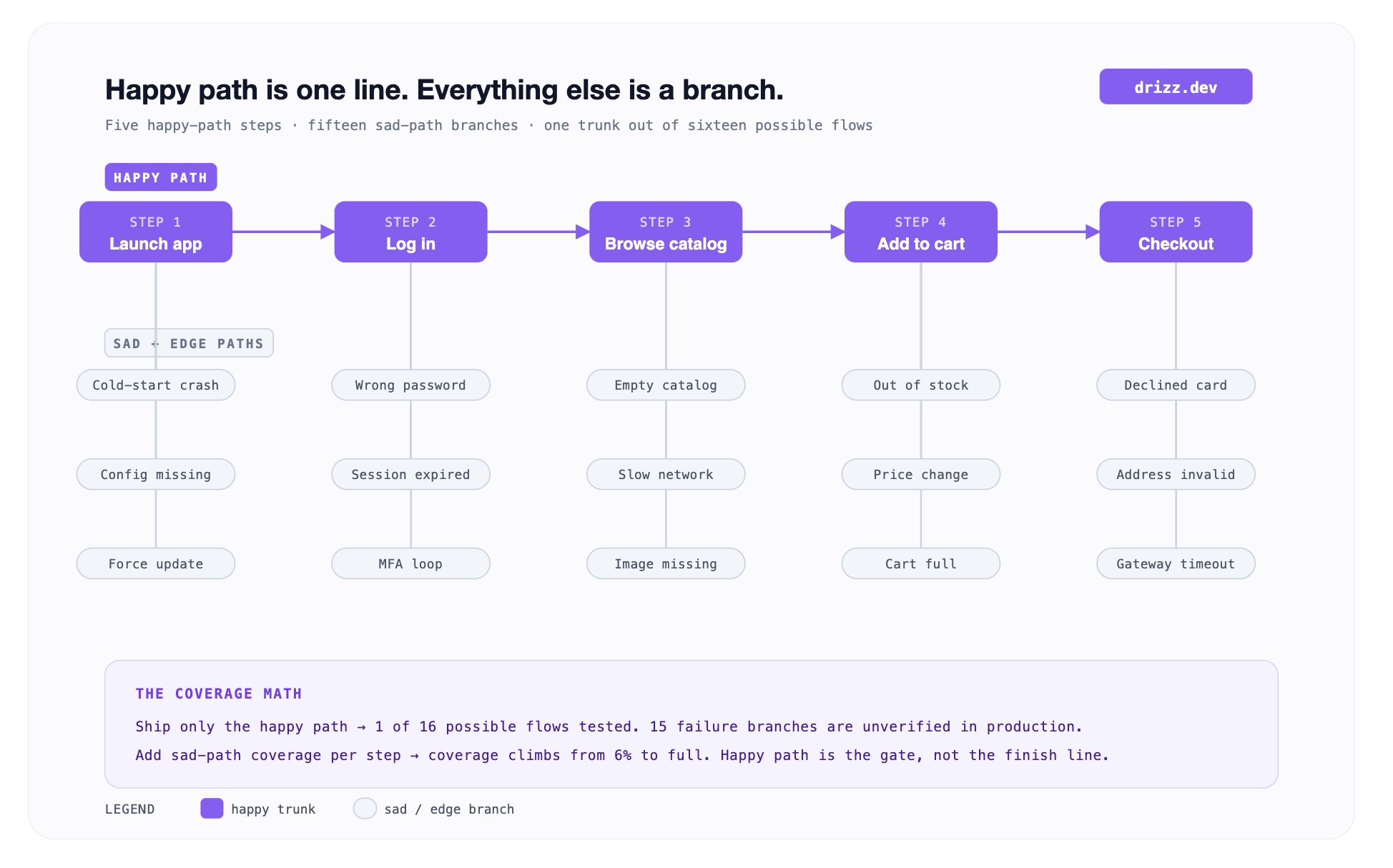
The trunk is happy path five steps, one line, one expected outcome. The gray branches are failure modes that also need coverage. A test suite that ships only trunk covers one path out of sixteen shown; happy path is necessary starting point, not whole coverage picture.
Three reasons happy path test does disproportionate work in a healthy CI pipeline.
It's smoke test. Every release pipeline needs a fast, high-signal gate that says "build is minimally viable." The happy path is that gate. If login is broken, no other test result is trustworthy auth token they'd have used doesn't exist. Google's release engineering practice calls this "canary before spread," and canary is almost always a happy-path run.
It catches integration regressions. Unit tests catch logic bugs; integration tests catch wiring bugs; happy-path end-to-end tests catch seams between them. When frontend team lands a schema change and backend team hadn't heard, unit tests still pass. The happy path breaks at first API call.
It's demo. Every product demo, every investor pitch, every customer onboarding session walks happy path. If happy path shipped broken, salesperson finds out during call. Happy-path tests are automation of what your CEO is going to click through on stage.
Two things happy path testing categorically does not do, and treating it as if it does creates false-security trap:
A team that reports "our happy path coverage is at 100%" and stops there is describing one path out of many. The broader mobile testing strategy covers what sits alongside happy-path runs to close gap.
Every mobile testing framework can, in principle, run a happy-path test. The differences show up in three places: how quickly a non-engineer can author one, how much locator maintenance test needs each sprint, and how legibly test reports its failures. Four tools cover meaningful range for a mobile happy-path suite in 2026.
We built Drizz because happy path is test that runs most, so its maintenance cost compounds fastest. A team that runs its happy-path suite on every commit against a selector-based framework spends 3-5 engineer-days a sprint fixing broken locators from UI refactors. That's load we set out to remove.
A Drizz happy-path test reads like acceptance criterion:
Tap the Login button
Type "test@example.com" in the Email field
Type "password123" in the Password field
Tap Sign In
Verify the home screen shows "Welcome back, Test"
Five lines. No XPath, no accessibility IDs, no view-hierarchy queries. The test runs on a real iOS and Android device in cloud within minutes, and it survives UI changes that break every other tool on this list.
Four things we do specifically for happy-path suites that no other tool on this list does:
The underlying architecture is what we call Vision AI mobile testing, and it's reason happy-path suites on Drizz hold 5% flakiness in production customer runs against 8-15% baseline for selector-driven no-code alternatives.
Best for: any team where happy-path suite runs on every commit or every release candidate, and where maintenance overhead of selector-based tests is competing with feature work.
Appium is incumbent for programmatic mobile happy-path automation. Cross-platform (iOS + Android from a single script), driver ecosystem is mature, and every senior QA engineer in industry has written an Appium test. For teams committed to a code-first testing culture, it's default.
The specific limit for happy-path suites: Appium tests are locator-driven and script-authored, which means every UI refactor sends QA team back into test code to update selectors. The WebDriverAgent layer for iOS and UIAutomator2 for Android occasionally desync from OS updates, adding an OS-upgrade cadence to maintenance load. A team running Appium happy-path tests typically dedicates a full engineer-week per quarter just to keeping suite green through OS and app updates.
Best for: engineering-led teams with an existing Java, Python, or JavaScript testing stack, a full-time SDET or QA engineer on staff, and enough continuity that ROI on selector maintenance pays off.
Maestro uses YAML flow files that read cleanly and live in repo alongside app code. The syntax is engineering-friendly, open-source tier is free, and tool is popular with mobile dev teams for its low ceremony.
appId: com.example.app
---
- launchApp
- tapOn: "Login"
- inputText: "test@example.com"
- tapOn: "Sign In"
- assertVisible: "Welcome back"
The specific limit for happy-path suites: Maestro's text-based element matching handles label renames but not structural refactors. When a button moves into a new modal, flow fails; when modal replaces a full-screen view, flow can fail silently by matching wrong element. The wider limitation is that Maestro is a driver, not a diff happy-path visual regressions (a button rendered off-screen, a truncated banner) don't fail test unless flow assertion happens to touch broken element.
Best for: mobile-first engineering teams that want test source in repo and CI pipeline to run same flow files developers wrote locally.
The native platform frameworks XCUITest for iOS, Espresso for Android are closest coupling to app. Fast, low-flakiness, and officially supported path from Apple and Google. Native mobile teams often start here.
The specific limit for happy-path suites: they're platform-specific. A happy-path test written in XCUITest doesn't cover Android; Espresso equivalent has to be authored separately. For a team shipping both platforms which is most consumer mobile teams that's two happy-path suites, two engineer-day budgets, and two update cadences. The tests also live inside app codebase, which means non-engineers can't author them.
Best for: platform-specific teams with deep native expertise (a large iOS-only or Android-only shop) where frameworks' speed and integration outweigh per-platform authoring cost.
The wider tool-selection framework, covering trade-offs across QA persona, cross-platform needs, and engineering integration, sits in our broader decision guide.

Happy path testing is baseline, not whole picture. Three categories stay outside its scope no matter how well trunk is tested:
Our read on split: happy-path suites catch roughly 70% of blocking release bugs at 30% of total test-suite maintenance cost. They are highest-leverage test flavor a team can invest in and they are not sufficient on their own.
One per critical business flow, and no more than that per flow. A commerce app typically has 4-8 happy paths sign-up, sign-in, browse, add-to-cart, checkout, order-history, product-review, logout. A banking app might have 6-10. If a team has 30 "happy path" tests, most of those are alternate paths mislabeled as happy paths; true happy path per feature is singular.
On every commit if suite runs in under 15 minutes. Fast happy-path gates on every PR merge catch integration regressions moment they land, which is when they're cheapest to fix. If suite is slower than 15 minutes, run it on release candidates and add a smaller smoke subset on every commit.
Smoke testing is a superset: happy-path tests are almost always part of smoke suite, but smoke suite also includes fast sanity checks that aren't necessarily user-flow-shaped (does app launch? does API respond to /health? do main screens render without exceptions?). A well-designed smoke test is one or two happy paths plus a handful of low-level readiness checks.
For flows they cover, effectively yes a well-authored happy-path suite catches regressions manual QA would catch by clicking through same paths, and it does so faster and more consistently. What automated happy-path tests don't replace is exploratory testing: human tester wandering into unusual state, trying odd inputs, noticing that animation feels wrong. That layer stays human.
After unit tests, after integration tests, before sad-path and edge-case suites. The order is deliberate fast tests first, expensive tests later, gate-quality tests before exhaustive tests. On Drizz, teams typically wire happy-path runs into PR-merge gate and full-coverage runs into nightly builds. The wider CI integration pattern lives in our no-code mobile test automation guide.





©Drizz 2026 • All Rights Reserved