•
Drizz raises $2.7M in seed funding •
•
Featured on Forbes
•
Drizz raises $2.7M in seed funding •
•
Featured on Forbes


Most mobile QA teams have a test suite. Very few have a testing strategy.
The suite answers "what runs today?" The strategy answers three questions at once: which devices, which coverage depth, at which point in release train.
Teams that skip strategy land in one of two failure modes. They test everything on every device on every commit burning CI budget while still missing OEM regression that ships to production. Or they gate on a single Pixel emulator, feel fast, and hear from support that Xiaomi users are seeing a crash CI never touched.
The device, coverage, and release axes are three separate decisions most teams collapse into one. The rest of this piece is how we think teams should decompose them.
If you own mobile release train, you should be able to read your matrix like a map every device, every test depth, every gate has a reason it's there.
A mobile app testing strategy is document that maps what you test to where you test it to when you test it.
What a QA lead actually needs is operational version: a matrix that tells any engineer which device, which suite, and which stage change they're pushing needs to pass.
The device matrix is one axis of that strategy, not whole thing. But it's axis most teams get wrong first it feels like a purchasing decision (real devices vs. cloud) when it's actually a coverage decision.
Mobile is uniquely hard here because of device fragmentation. Android alone has thousands of active device models, and OEM skins Samsung One UI, Xiaomi HyperOS, OPPO ColorOS each introduce behaviors AOSP reference builds don't reproduce.
iOS is simpler on OEM axis but not on OS axis. The tail of iOS 15 users on old iPhones is still large enough that fintech and health apps can't drop it silently.
Three constraints anchor strategy:
The rest of this article is how to resolve those three constraints into a single matrix.
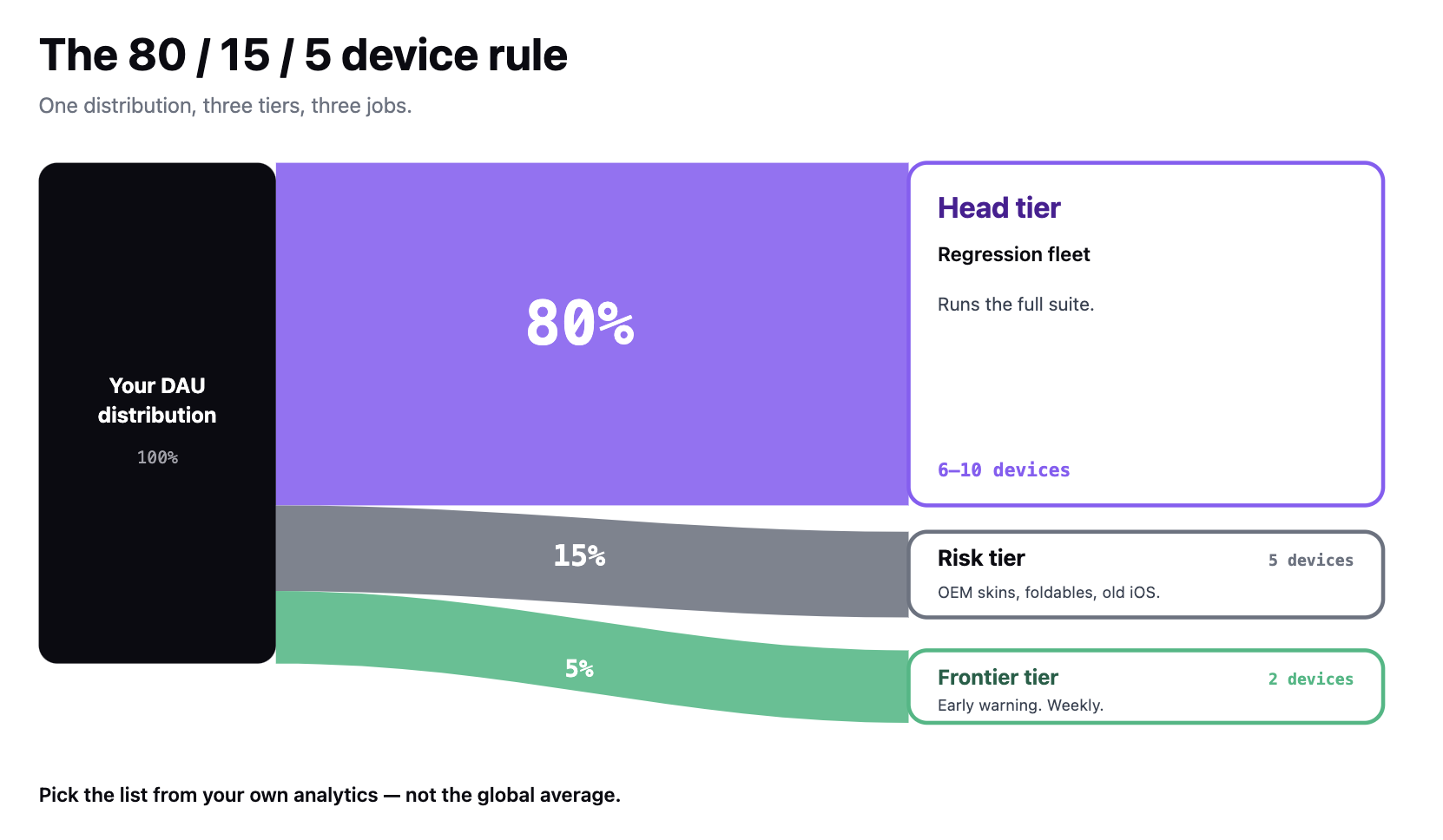
The 80/15/5 rule is shortcut that works. It comes out of way mobile production distributions actually look long-tailed, with a sharp head.
Writing split down forces a conversation.
When Product asks why a Xiaomi Mi Note bug wasn't caught, answer is either "that device is in 15%, so we test top-10 flows on it, and this bug was in flow #47" (defensible) or "we don't test on Xiaomi at all" (a strategy hole you now have to close).
Pick device list from a single source of truth. StatCounter and DeviceAtlas are useful cross-references, but your own analytics beats every third-party dataset those are your users, not global average.
If you don't have first-party device data yet, that's first project. You can't build a strategy on a distribution you're guessing at.
Whether those devices are real or emulated is a separate call, and it's not always "real wins." Emulators are fine for functional coverage on head of distribution.
The Android emulator vs. real device split matters most for biometric, camera, NFC, GPS accuracy, battery, thermal throttling, and anything touching Play Integrity or App Attest. Real-device testing earns its cost for risk tier and for release-gate stage.
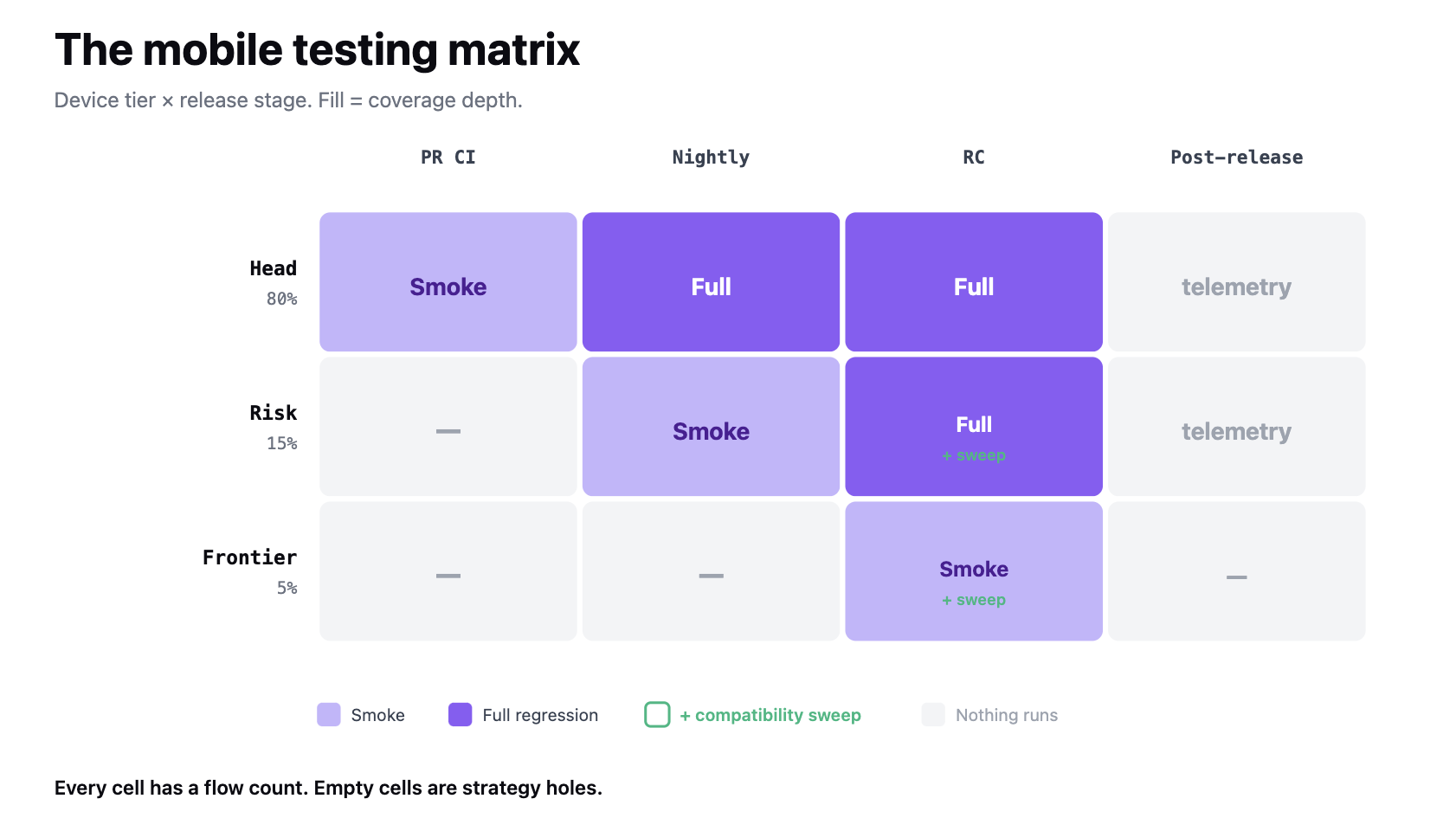
Not every device runs every test. The coverage axis is how deep suite goes on a given target, and it's what turns a device list into an actual matrix.
Four coverage depths cover ground:
The matrix comes together by crossing coverage depths against device tiers.
On 80% head, run all four depths. On 15% risk tier, smoke every merge and full regression on RC. On 5% frontier, smoke and compatibility on a weekly cadence, gated by a human owner who signs off.
Full regression is where 90% of test-maintenance cost lives, which is why teams that don't invest in reducing mobile test maintenance end up cutting corners on it.
Two anti-patterns to name:
The release-stage axis is where most strategies fall apart, because a good matrix moves as code moves. Four stages, four different postures.
Pre-commit / IDE. Unit and component tests on developer's machine. No device involved.
For teams with a Compose or SwiftUI-heavy codebase, snapshot tests can catch UI regressions before they hit CI. This is fastest and cheapest layer, and least strategy-heavy no device matrix decision to make.
Per-PR CI. Smoke suite on 2–3 head-tier devices. The gate that says "your PR didn't break app for our biggest cohort."
The rule here is time. This stage must finish in under 10 minutes or developers route around it. Parallelizing across devices is only way to hold that budget parallel real-device testing in CI pipelines is worth its own discussion. Serial runs on more than one device blow budget.
One CI caveat worth naming: some platforms Drizz included expose test triggers as an authenticated HTTP call that returns an execution ID, not run outcome. Your PR CI job goes green as soon as run starts, not when it finishes.
To actually block a PR on Drizz results, poll report or gate against a report webhook instead of trigger response.
Nightly / merge queue. Sanity + full regression on head-tier fleet, smoke on risk-tier fleet.
Where you find regressions PR CI is too small to catch. This is also where parallelism becomes essential local device runs execute one test at a time, while cloud and private-device runs run many in parallel, so nightly usually means cloud. The on-call owner triages results before team starts next day.
Release candidate. Full regression on head, full regression + compatibility sweep on risk, smoke on frontier.
Real devices for anything that touches hardware. Human sign-off required. This is where quality gates matter automation reports pass/fail, a QA lead decides whether failures are shippable.
The mistake teams make here is treating stages as cumulative every stage running everything previous stage ran, plus more.
Each stage answers a different question with a different budget. PR CI answers "did this change break top of funnel in last 10 minutes." RC answers "will this release survive contact with real users across our whole distribution." Different tests, different depths, different tolerances for time.
Here's a slimmed-down structure. Cell values are illustrative point is shape, not exact numbers:
| Stage | Head tier8 devices | Risk tier5 devices | Frontier tier2 devices |
|---|---|---|---|
| PR CI | Smoke (12 flows) | ||
| Nightly | Sanity (60) + Full regression (420) | Smoke (12) | |
| Release candidate | Full regression (420) | Full regression + Compatibility sweep (42) | Smoke + Compatibility sweep |
| Post-release monitoring | Crash & performance telemetry | Same | Same |
Two things worth noting about how it's written.
First, every cell has a count of flows, not a vague "runs suite." That's discipline if you can't count flows, you can't budget time.
Second, a release-candidate cell for risk tier includes a compatibility sweep head tier doesn't. That's whole point of tier split devices in risk tier exist to catch things head tier can't.
The matrix is a document, not a config file but on Drizz, each cell maps to a test plan that pins tests, devices, dataset binding, and concurrency for that stage. It changes when DAU distribution shifts (a new market or a new device crosses 5% usage), when release cadence changes, or when a P0 shows strategy had a hole.
Version control it, review it quarterly, and put a name against review.
The 80/15/5 rule and four coverage depths are tool-agnostic. They'd work with Appium, Espresso, XCUITest, or anything. But which tool you use changes how expensive each cell is and the shape of what's affordable.
Script-based frameworks (Appium, Espresso, XCUITest, and Detox) have a coverage ceiling that isn't set by device budget; it's set by maintenance cost.
Every UI change forces locator updates. Teams running Appium at scale typically spend a significant portion of a QA sprint on locator maintenance rather than new coverage. That's the reason so many teams underinvest in risk and frontier tiers; they can't afford to.
The pattern is same across shops that replace their Appium grids with a vision-first setup: tier split gets cheaper when per-flow maintenance cost drops.
We built Drizz Vision AI on argument that a vision-based engine resolves the maintenance-vs.-coverage trade-off. Each step describes intent in plain English, "tap search icon, type running shoes, tap first result," and engine reads screen and locates target at run time without selectors, XPath, or accessibility IDs.
Two mechanics matter for matrix economics. Caching reuses how a step resolved on a screen engine has seen before, so a suite gets faster and cheaper as it warms up.
Self-healing repairs tap, type, and swipe failures mid-run around five attempts per run, badged in report so a restyled dialog or renamed button doesn't fail whole suite.
That means same team that could afford full regression on 8 devices can afford it on 13, and risk tier stops being where you cut corners. The compatibility sweep is expensive to author in a locator-based tool because every OEM skin needs its own selectors and becomes writable in a single pass.
Whichever tool you use, price out your matrix in engineer-hours per flow per device per stage before you commit to it. On usage-metered platforms, factor in per-step billing. Drizz meters each step in DT, and cached steps cost fewer DT than freshly resolved ones. If a cell doubles when you switch tools, the whole strategy shifts.
Four triggers, in order of frequency:
The last one separates good QA leads from good QA leads with a strategy.
When capacity opens up, default is to write more tests for flows team already knows. The higher-leverage move is to widen tier, not deepen head. The head is already the best-covered surface, and returns diminish. The risk and frontier tiers are where ROI lives.
A mobile app testing strategy is three questions crossed against each other: which devices, which coverage depth, which release stage. The deliverable is a matrix with a flow count in every cell.
Pick device list from your own analytics using 80/15/5 split. Assign coverage depths, smoke, sanity, full regression, compatibility sweep to tiers where each earns its cost. Move those depths across release stages, not cumulatively, and put quality gates at boundaries.
Version-control matrix: review it quarterly and rebuild it when distribution, cadence, or capacity shifts.
If you can't point to your matrix, you have a suite, not a strategy. Once matrix exists on paper, tooling and budget questions answer themselves; you can price each cell and shift where it's expensive.

Review matrix quarterly at minimum and rebuild when any of four triggers fires: a DAU distribution shift (new market, a device model crossing 5% share), a release cadence change that shrinks RC budget, a P0 that matrix missed, or a team-capacity change that adds or removes automation headcount.
The head tier covers 80% of DAU and runs full suite. The risk tier is 15% models that account for a small share of users but a disproportionate share of crashes or support tickets (old iOS, foldables, aggressive OEM skins). The frontier tier is 5% new OS betas and next-gen hardware, run weekly for early warning.
For PR CI, emulator smoke on 2–3 head-tier devices is usually fine; the stage must finish in under 10 minutes, and emulators handle functional coverage on top of distribution well enough. Real devices belong at nightly and release-candidate stages, especially for risk tier and anything touching hardware, biometrics, or platform integrity APIs.
Vision-based automation drops per-flow maintenance cost through two mechanics. Caching turns re-runs on same screen into a fraction of cost, and self-healing repairs failed steps mid-run when UI shifts. Teams typically move from affording 8 head-tier devices to 13 on same headcount.





©Drizz 2026 • All Rights Reserved