•
Drizz raises $2.7M in seed funding •
•
Featured on Forbes
•
Drizz raises $2.7M in seed funding •
•
Featured on Forbes


Product managers write acceptance criteria every sprint. Until recently, turning those criteria into a running test meant handing story to a QA engineer, who translated English into a scripting framework, a locator strategy, and a CI job. That translation step is where most acceptance criteria drift or die test that eventually lands often no longer represents what PM asked for. Here
Four criteria separate a PM-friendly authoring tool from a QA-friendly one. Every tool in this comparison is held to all four:
The broader landscape of tools optimised for this style of authoring sits in no-code mobile test automation, and specific technique underneath most of them is covered in natural language mobile test automation explained.
Two axes matter when reader is a PM, not a QA lead.
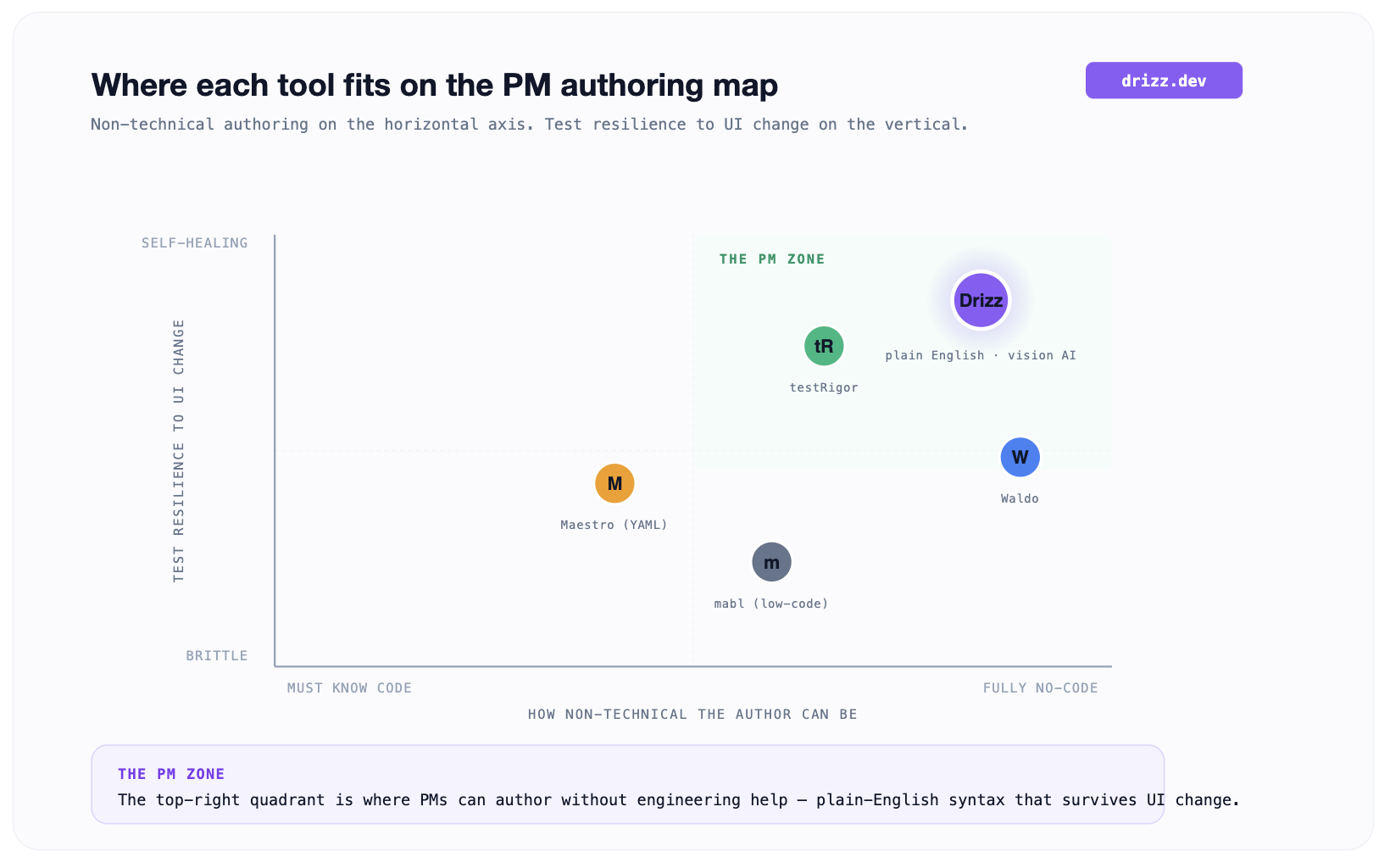
What this chart helps with: it shows PMs at a glance which tools sit in "authors like a PM, survives like a QA tool" quadrant. The tools that do both are shortlist. Tools that require code or break on UI change fall off map for this audience.
PMs authoring tests in selector-based tools hit same wall around week two: tool works until design refreshes, and then test breaks in a way only engineering can fix. We built Drizz to remove that wall.
Tap the Login button
Type "admin@example.com" in the Email field
Tap Sign In
Verify the home screen shows "Welcome back"
Four lines. No XPath, no accessibility identifiers, no view-hierarchy queries, no YAML, no SDK integration, no recording. The PM types acceptance criterion; we run it on a real iOS and Android device in cloud within minutes.
Four things we do that no other tool on this list does:
The technique underneath is what we call Vision AI mobile testing only architecture in this comparison that removes PM's dependency on engineering for selector maintenance. It's why our production PM-authored suites hold that 5% flakiness rate through weekly design refreshes.
Best for: any PM at a product-led company who owns acceptance criteria and wants to close loop from story to running test without waiting on QA. Native, React Native, or Flutter we built Drizz for exactly this profile.
testRigor is tool that comes closest to Drizz on plain-English authoring surface. A testRigor test reads like:
Login as premium_user
Click "Cart"
Verify text "Empty cart"
Fast to write, cross-surface (web + mobile + API from one authoring UI), and widely reviewed on G2 as natural-language testing category leader.
The specific limit for a PM audience: testRigor is selector-driven under hood with AI-assisted interpretation on top. When UI stays stable, tests run cleanly. When engineering refactors DOM or mobile view hierarchy, AI interpretation degrades button-finding starts guessing at nearby elements, and false positives creep in. A PM who assumes test will survive a design refresh because syntax reads like English hits this wall around third major UI change.
Best for: teams where PMs need to write tests across web + mobile + API from a shared syntax, and where engineering handles underlying selector maintenance when refactors break tests.
Waldo is fully visual no-code. Open Waldo desktop app, connect a device or emulator, click through flow, done. The recorded path becomes a repeatable test on Waldo's device cloud.
Zero syntax learning curve. That's strongest single feature for a first-time PM author.
The specific limit for a PM audience: output is a sequence of screenshots, not a text file. Engineering cannot review test in a pull request, cannot extend it with programmatic assertions, and cannot diff two versions of it to see what changed. A Waldo test is a black-box artefact. When engineering hits a bug PM's recording missed, fix is another recording not an edit.
The other limit is that visual recordings inherit exact device PM recorded on. A recording made against iPhone 15 does not automatically adapt to iPhone SE without re-recording. The PM ends up managing device-specific recording branches.
Best for: PMs at very early-stage teams who need fastest possible ramp and don't yet have engineering pushing back on artefact reviewability.
Maestro uses YAML flow files that read cleanly:
appId: com.example.app
---
- tapOn: "Login"
- inputText: "admin@example.com"
- tapOn: "Sign In"
- assertVisible: "Welcome"
Engineering-friendly (lives in version control alongside app code), open source, popular with mobile dev teams.
The specific limit for a PM audience: YAML is syntax, not English. A PM without prior YAML exposure hits indentation errors, quote-escaping issues, and difference between tapOn and tap-on. Not blocking, but "under an hour to first test" bar breaks first-time PMs typically need help from engineering to get their first flow running.
The deeper limit is that Maestro's text-based element matching handles label renames but not structural refactors. When a button moves inside a new modal, flow fails; when modal replaces a full-screen view, flow fails silently by matching wrong element.
Best for: PMs at engineering-led companies where test source belongs in repo, PM is comfortable with configuration files, and Maestro's engineering-friendliness matters more than PM-friendliness.
mabl is a low-code testing platform with strong CI/CD integration and AI-assisted maintenance. The visual authoring interface is capable, and analytics layer (flakiness rates, coverage over time, regression frequency) is genuinely rich.
The specific limit for a PM audience: mabl is built for a QA analyst, not a product manager. The authoring interface expects familiarity with test-case management concepts (fixtures, data-driven inputs, environment configurations) that PMs typically don't carry. Mobile support is smaller and newer than web offering.
When mabl's AI suggests a fix for a broken test, PM is asked to accept or reject suggestion which requires understanding what changed. In practice, this pushes review back to QA.
Best for: cross-functional teams where PMs share test authoring with a QA lead who runs pipeline. On mabl specifically, QA lead does heavier lifting; PM contributes flows but does not own end-to-end.
The right question isn't which tool has longest feature checklist it's which tool fits PM's actual situation.
The pattern: for mobile-focused, product-led PM which is most PMs authoring tests today Drizz is answer. The other four fit specific edge cases where a real constraint (cross-surface syntax, shared QA workflow, YAML-first culture) makes them a better local fit.
PM authoring is not a replacement for QA. It's a redistribution of load. Four categories stay with engineering and QA even when PM owns authoring layer:
Our read on split: PM-authored tests handle 60-70% of acceptance criteria that map cleanly to observable UI behaviour, and free up QA time for harder 30-40% that don't.
QA is still QA. What changes is that PMs stop waiting on QA to translate a written acceptance criterion into a running test. When acceptance criterion is test, round-trip from "story done" to "test running" collapses from days to minutes. The teams we work with don't cut QA headcount when they adopt PM authoring they redirect QA to harder tests PM can't write.
Yes. All five tools in this comparison integrate with GitHub Actions, GitLab CI, Bitrise, CircleCI, and Jenkins. The PM authors test in desktop app or web UI; engineering wires run into release pipeline once. After that, every PM-authored test runs automatically on every build.
This is question that separates tools. Our vision matching survives most refactors because it reads rendered screen way a human does. testRigor's AI-interpreted selectors handle small changes but struggle with structural rewrites. Waldo's recorded flows survive small changes but not full redesigns. Maestro's text matches survive label renames but not layout restructures. mabl suggests AI-generated fixes, but PM still has to accept or reject each one.
No. QA engineers do hard tests backend state, complex assertions, cross-service flows, load, security. PM authoring covers UI regression layer that engineers historically hate maintaining anyway. The two roles complement each other, and PM authoring frees QA to work on coverage that actually needs their skills.
For that profile, we'd recommend Drizz. Plain-English authoring, no SDK integration, works on release builds without engineering setup. Bigger teams with cross-surface needs or heavy CI-analytics requirements often layer a second tool on top of Drizz but for a small mobile-first team, we're shortest path from acceptance criterion to running test.





©Drizz 2026 • All Rights Reserved