•
Drizz raises $2.7M in seed funding •
•
Featured on Forbes
•
Drizz raises $2.7M in seed funding •
•
Featured on Forbes


Test data management is a programmatic discipline of planning, creating, masking, subsetting, and provisioning realistic datasets to non-production environments so testers get the exact data they need, when they need it, while staying compliant with GDPR, HIPAA, CCPA, and PCI-DSS. TDM sits between production data (source of truth) and every downstream environment (dev, QA, staging, UAT, and performance labs). Its job is to keep those environments useful for testing without leaking anything a compliance officer would regret.
The category grew out of a simple pain: developers and testers spending days waiting on DBAs to hand-craft data copies or waiting on manually created synthetic fixtures that don't resemble production. TDM platforms replace that manual choreography with self-service portals, API-driven provisioning, and repeatable pipelines. Every serious enterprise data operation has TDM in some form by 2026; the only real question is whether it's built with a commercial platform or stitched together from scripts.
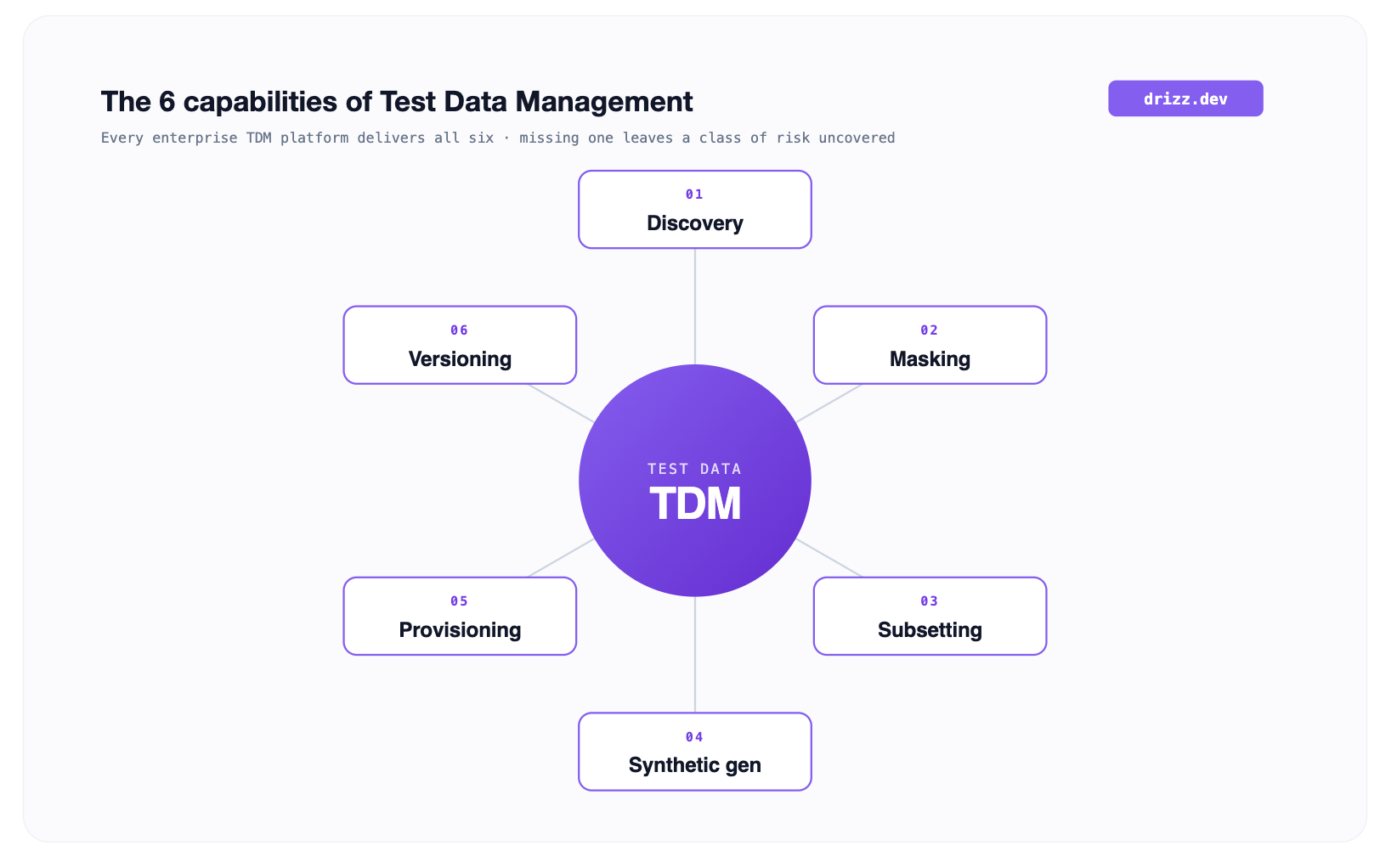
Every enterprise TDM platform delivers all six of these. A vendor missing one leaves you back in manual mode for that slice.
1. Data discovery. Scan production source systems to catalogue every table, column, and field that contains personally identifiable information (SSNs, credit card numbers, email addresses, birthdates, and medical record numbers). Modern discovery uses pattern matching, format checks, and increasingly ML classifiers to catch fields your DBA forgot were sensitive. Without discovery, masking is blind guessing.
2. Data masking. Replace sensitive values with realistic, format-preserving fakes. "John Smith, SSN 123-45-6789" becomes "Adam Wilson, SSN 456-78-9012" same shape, no real person. Effective masking preserves referential integrity (same real customer maps to same masked customer across every table), format (dates stay dates, emails stay emails), and statistical distribution (masked data behaves like original for testing).
3. Database subsetting. Extract a compact but mathematically coherent slice of a massive production dataset. Instead of shipping a 40-TB Oracle mirror to staging, subsetting pulls a 400-GB slice that maintains foreign-key integrity, referential completeness, and statistical validity. The reduction is often 100× or more, which shrinks storage footprint, refresh time, and cloud egress costs by same factor.
4. Synthetic data generation. Manufacture testing data from scratch when production is unavailable, restricted, or insufficient. Synthetic generation is essential for new-feature testing (where no production examples exist yet), regulated environments (where even masked prod data has restrictions), and edge-case coverage (rare-value combinations you'd never see enough of in production).
5. Automated provisioning. Deliver prepared datasets to test environments on demand via self-service API, CI/CD pipeline hook, or scheduled refresh. A modern TDM setup lets an engineer request "payment-flow test dataset for QA" from a CLI and have it loaded in minutes rather than filing a ticket with a DBA.
6. Data versioning. Save snapshots of specific data states so tests can roll back to a known baseline. Running a regression test that depends on "state of users table on 2026-01-15" becomes possible when versioning is in place. Without it, every test that modifies data risks affecting next test in suite.
The business case for TDM comes down to four load-bearing benefits, ranked roughly by how often we hear them cited by buyers.
Four regulatory frameworks show up in almost every TDM procurement conversation. The specific obligations depend on your industry and user base, but direction is consistent: no real user PII in non-production without masking or explicit consent.
Combined, an effective floor is: any team handling regulated data must have a masking or synthetic-generation pipeline in place before production data enters staging.
The typical enterprise combines all four, weighted differently by use case.
Four platforms cover meaningful range of enterprise TDM in 2026. All four are commercial with sales-led onboarding public per-user pricing is unusual in this category and every buyer should expect a demo-plus-quote cycle. All four vendor URLs below verified live in July 2026.
Delphix, now part of Perforce, is data virtualization heavyweight and platform most enterprise buyers encounter first. Instead of copying production data to staging, Delphix creates lightweight virtual copies that share underlying storage but present as independent environments. A 40-TB production database can generate 20 virtual staging environments consuming only a few hundred gigabytes total.
Best for: high-velocity CI/CD environments that need many parallel test environments spun up and torn down constantly. The virtualization model shines here; provisioning a fresh copy takes minutes instead of hours.
Pricing: enterprise, quote-based. Reference Perforce Delphix product page.
Informatica TDM is incumbent for organizations already invested in broader Informatica data platform. Deep multi-cloud governance, comprehensive ETL operations, and tight integration with Informatica's data quality and data catalog products.
Best for: cloud-native technical stacks where Informatica is already data platform of choice. The value proposition strengthens dramatically when TDM sits alongside Informatica's other products in one procurement. Note: Informatica has been repositioning TDM as a capability inside its broader Data Governance, Access & Privacy stack, so standalone product footprint has narrowed.
Pricing: enterprise, consumption-based quote. Reference Informatica TDM's product page.
IBM Optim is an enterprise heavyweight for regulated environments and legacy systems. Deep support for mainframe data extractions, DB2, and older enterprise databases most modern tools don't touch. Popular in banking, government, and heavily-regulated industries.
Best for legacy legacy database environments (mainframes, DB2, older Oracle) where modern tools lack driver depth. Also standard choice for organizations with existing IBM procurement relationships.
Pricing: enterprise, quote-based, license-based. Reference IBM Optim's product page.
K2view treats test data as micro-segments, an entity-based model where each business entity (customer, order, patient) is a self-contained dataset with all its related records. This structure makes provisioning specific test scenarios (a customer with 3 orders and an open dispute) dramatically faster than table-by-table subsetting.
Best for: high-complexity enterprise architectures with many interrelated systems, where testers need scenario-specific slices of data rather than whole-table subsets. Common in banking, telecom, and insurance.
Pricing: enterprise quote-based. Contact via K2view's TDM tools page.
Four questions reduce the vendor list quickly.
Multi-terabyte production databases with many parallel staging environments push you toward Delphix's virtualization approach. Nothing else in the category matches its ability to spin up dozens of virtual copies from one physical footprint. Sub-terabyte or single-environment deployments work fine with subsetting-based approaches (K2view, Informatica TDM, IBM Optim).
All four platforms support both, but their emphasis differs. Delphix and Informatica lean masking-first with strong virtualization or ETL underpinnings. IBM Optim's core strength is masking and subsetting on regulated / legacy databases. K2view's entity-based model works especially well for scenario-driven synthetic generation.
HIPAA-heavy healthcare, PCI-heavy fintech, and regulated banking all push toward masking-first platforms with strong audit trails Delphix, IBM Optim, and Informatica TDM each have long compliance-heavy customer references.
Informatica shops default to Informatica TDM. IBM shops (or teams with mainframe / DB2 workloads) default to Optim. Greenfield selections and modern data-mesh architectures typically land on Delphix or K2view depending on whether virtualization or entity-based provisioning matters more.
Different layer. TDM manages data used for testing masked users, synthetic accounts, and versioned snapshots. Drizz is usedexecution layer for mobile UI testing. Once your TDM platform has provisioned test users and payment methods, Drizz runs actual mobile tests on real iOS and Android devices against that data.
A typical modern stack looks like this: Delphix (or Informatica TDM, IBM Optim, or K2view) provisions test users, masked payment records, and edge-case scenarios into staging. A CI job pulls credentials for those test users. Drizz runs mobile UI tests using those credentials on real cloud devices, catching visual and interaction regressions vision model spots. Results push back into TestRail or Zephyr, mapped to specific test-data scenarios that were used. Two distinct layers, two distinct tools, one integrated pipeline.
If you landed here from a mobile-testing search, our Vision AI mobile testing explainer covers the execution layer, and our test data management for mobile apps guide covers mobile-specific TDM strategy that sits between enterprise TDM and mobile execution.

No. TDM manages datasets used for testing, sourcing, masking, subsetting, and provisioning. Data testing validates that data flowing through pipelines is correct through schema checks, freshness monitors, and anomaly detection. Different problems, different tools. Our data testing tools guide covers the second category.
Only if anonymization is genuinely irreversible and the process is auditable. "I replaced name column" is not anonymization; it's obfuscation, and it can often be reversed by correlation with other columns. Real anonymization uses format-preserving encryption, tokenization, or synthetic replacement, and it holds up under adversarial analysis.
Enterprise TDM is almost universally quote-based with per-database, per-environment, or per-user pricing. Deployments typically range from $50K/year for small teams to $500K+/year for large enterprises with many environments and complex data. Every vendor requires a demo and negotiation cycle; there is no self-serve tier at the enterprise end of this market.
Not at first. Under 20 engineers, Faker + Stripe sandbox + a manual list of 20 named test users cover most needs. The move to a paid TDM platform typically happens around 50 engineers, or first regulated-industry contract, or first HIPAA/GDPR compliance conversation with a security officer.
Via API. Modern TDM platforms expose REST APIs that CI jobs call to provision, refresh, or version data before test runs. The typical pipeline is: (1) job starts; (2) job calls TDM to provision specific test dataset; (3) tests run; (4) job calls TDM to release or reset dataset. Total overhead is usually 30-60 seconds per test suite.
Masking starts from real data and replaces sensitive fields. Synthetic generation starts from scratch and generates new fake data matching a schema. Masking preserves real usage patterns (which is valuable for finding realistic edge cases); synthetic generation eliminates all PII risk (which is valuable for regulated environments). Most mature TDM programs use both masking for regression suites and synthetic for greenfield feature testing.
No different purpose. A data warehouse stores production data for analytics; a TDM platform manages test copies of that data for QA. Both draw from the same production sources but for different downstream users.





©Drizz 2026 • All Rights Reserved